
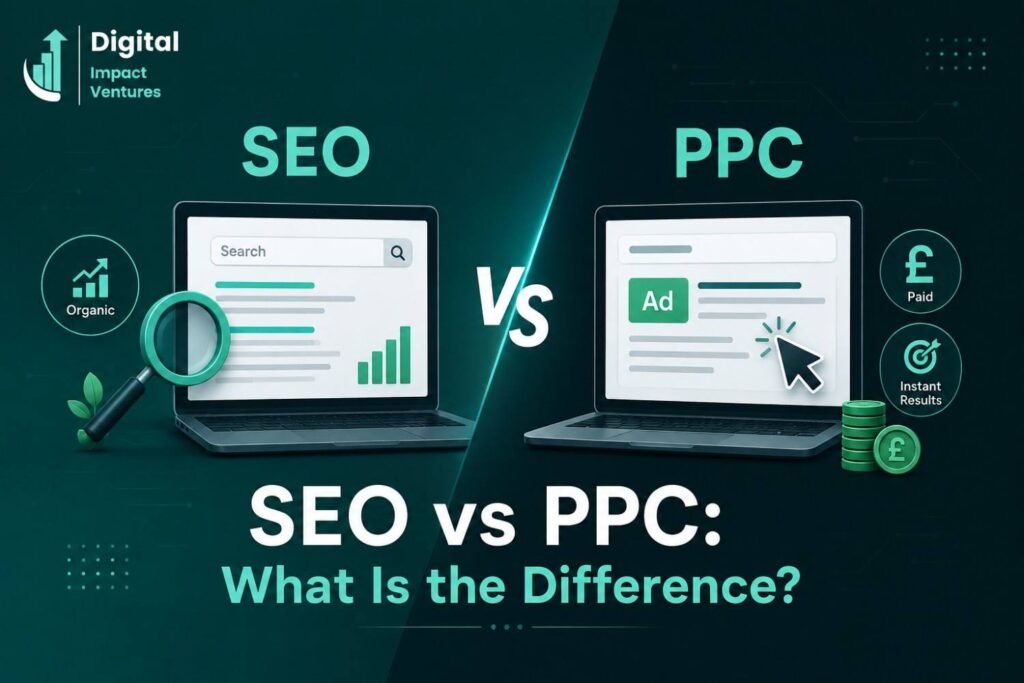
When it comes to driving traffic to a website, two strategies dominate the conversation: SEO and PPC. Both aim to help businesses get found by potential customers on search engines, but they work in fundamentally different ways, come with different costs, and deliver results on very different timelines. Understanding SEO vs PPC: what is the difference?, and knowing when to use each, is essential for building an effective digital marketing strategy, whether you’re working with an seo company in-house or partnering with an outside specialist.
This guide breaks down exactly what SEO and PPC are, how they compare, and how businesses can decide which approach, or combination of seo services and PPC services, is right for them.
What Is SEO?
SEO, or search engine optimization, is the practice of improving a website so it ranks higher in organic search traffic results on platforms like Google. Rather than paying for placement, SEO focuses on earning visibility through relevance, quality content, and technical optimization.
SEO involves several core components, including keyword research to understand what potential customers are searching for, on-page optimization to make individual pages more relevant and useful, and off-page optimization such as link building to build a site’s authority. Search engines use complex algorithms to evaluate all of these factors, along with signals like domain authority and user experience, to determine where a page ranks on the search engine results page (SERP) for a given search. Businesses offering organic seo services typically manage all of these moving parts together as part of an ongoing strategy.
What Is PPC?
PPC, or Paid search advertising, is a model where businesses pay to have their ads appear at the top of search results, typically through platforms like Google Ads. Unlike organic rankings, PPC placement is essentially bought, with businesses bidding on specific keywords relevant to their products or services.
With PPC, advertisers only pay when someone actually clicks their ad, a pricing model known as Cost per click (CPC). The CPC can vary significantly depending on competition for a given keyword, industry, and the quality of the ad itself. Platforms also track Click-through rate (CTR), along with bid amount and Quality Score, a measure of how relevant and useful an ad is, to determine ad rank and how much an advertiser actually pays.
Key Differences Between SEO and PPC
While both SEO and PPC aim to increase visibility on search engine results pages, the way they achieve this, and the trade-offs involved, differ significantly.
Cost Structure
SEO doesn’t involve paying for clicks or placement directly, though it does require investment in content creation, technical optimization, and often ongoing professional support from a seo company. PPC, on the other hand, involves direct payment for every click an ad receives, meaning costs scale directly with traffic volume.
Time to Results
One of the most significant differences is how quickly each approach delivers results. PPC can generate traffic almost immediately, once a campaign is live, ads can start appearing and driving clicks within hours. SEO, by contrast, is a long-term strategy, often taking several months to see meaningful improvements in organic rankings, since search engines need time to crawl, index, and evaluate a website’s relevance and authority.
Longevity of Results
PPC traffic stops the moment you stop paying for ads, there’s no lasting benefit once a campaign ends. SEO, however, builds long-term value, well-optimized content and strong rankings can continue driving organic traffic for months or years without ongoing ad spend, though maintaining rankings does require continued effort. This is exactly why is SEO considered a long-term strategy compared to the short-term nature of paid campaigns.
Trust and Credibility
Many users trust organic search results more than paid ads, since organic rankings are seen as earned rather than bought. This means strong SEO performance can carry a credibility advantage that PPC ads, clearly labelled as advertisements, don’t always enjoy.
The Pros and Cons of SEO
SEO offers substantial long-term value, but it requires patience and sustained effort.
Advantages of SEO:
- No direct cost per click, unlike PPC
- Builds long-term, sustainable traffic
- Often carries more trust and credibility with users
- Improves overall website quality and user experience
Disadvantages of SEO:
- Takes significant time to see results
- Requires ongoing content creation and optimization
- Rankings can be affected by algorithm changes
- Highly competitive keywords can be difficult to rank for organically
The Pros and Cons of PPC
PPC offers speed and control, but at an ongoing cost.
Advantages of PPC:
- Delivers immediate visibility and traffic
- Highly measurable, with clear data on cost per click and conversions
- Allows precise targeting based on keywords, location, and audience
- Easy to test and adjust campaigns quickly
Disadvantages of PPC:
- Costs can add up quickly, especially for competitive keywords
- Traffic stops as soon as spending stops
- Requires ongoing budget to maintain visibility
- Can be less trusted by users compared to organic results
Which Is Better, SEO or PPC, for Small Businesses?
Which is better, SEO or PPC? There’s no single answer, the right choice depends on a business’s goals, budget, and timeline. Small businesses with limited budgets but more time to invest may find SEO more cost-effective in the long run, since it doesn’t require ongoing ad spend once rankings are established. Many turn to one of the best seo companies for small business owners can find locally to help build that foundation properly from the start.
On the other hand, businesses needing immediate visibility, such as a new business launch, a time-sensitive promotion, or a highly competitive market where organic ranking would take too long, may benefit more from PPC’s ability to generate quick, measurable results.
Is SEO or PPC More Cost-Effective?
Is SEO or PPC more cost-effective? It depends on the timeframe you’re measuring. In the short term, PPC often delivers faster, more predictable returns, since you’re paying directly for visibility. Over the long term, however, SEO tends to be more cost-effective, as organic rankings continue generating traffic without ongoing per-click costs once they’re established.
Measuring ROI: SEO vs PPC
Measuring return on investment looks quite different for each approach. With PPC, ROI is relatively straightforward to calculate, tracking cost per click, conversion rate, and overall ad spend against revenue generated makes it easy to see exactly what a campaign is delivering.
SEO’s ROI is less immediate and slightly more complex to measure, since organic traffic builds gradually over time. However, once rankings are established, the ongoing cost of maintaining that traffic is often significantly lower than the equivalent traffic generated through PPC, making long-term SEO ROI potentially much stronger, particularly for businesses playing the long game.
Can SEO and PPC Work Together?
Can SEO and PPC work together? Rather than choosing one over the other, many successful digital marketing strategies combine both, using each to complement the other’s strengths. PPC can provide immediate visibility and data on which keywords convert well, insight that can then inform long-term SEO content strategy.
Similarly, businesses can use PPC to maintain visibility for competitive keywords while SEO efforts are still building organic rankings, ensuring consistent traffic throughout the transition. This combined approach allows businesses to capture both immediate and long-term search visibility, and it’s a strategy many local firms, including an SEO agency in Colchester, recommend to clients who want the best of both worlds.
Factors That Influence PPC Costs
Several factors affect how much a business pays for PPC advertising, including keyword competitiveness, industry, geographic targeting, and the quality of the ad and landing page itself. Highly competitive industries, such as legal services or insurance, often have significantly higher costs per click than less competitive niches.
Quality Score plays a significant role too, ads with higher relevance and better landing page experience can achieve better ad rank at a lower cost per click, rewarding advertisers who invest in genuinely useful, well-targeted campaigns rather than simply outbidding competitors. Businesses searching for PPC services near me often find that local specialists understand regional competition and pricing far better than a generic, one-size-fits-all provider.
Factors That Influence SEO Success
SEO success depends on a combination of technical optimization, content quality, and off-page authority signals. Search intent plays a crucial role, content needs to genuinely match what users are searching for, not just include the right keywords. Conversion rate optimization also matters here, since ranking well only delivers value if visitors actually take meaningful action once they arrive.
Technical factors like site speed, mobile-friendliness, and clear site structure also influence rankings, alongside external factors such as backlinks from reputable websites, which signal authority and trustworthiness to search engines. For businesses operating across multiple regions or countries, international seo services add another layer of complexity, requiring careful attention to language targeting, local search behaviour, and region-specific technical setup.
Choosing the Right Strategy for Your Business
When deciding between SEO and PPC, or how to balance both, consider your timeline, budget, and specific goals. If you need results quickly and have a budget available for ongoing ad spend, PPC offers a fast, measurable path to visibility. If you’re building toward long-term, sustainable traffic and are willing to invest time in content and optimization, SEO offers stronger long-term value.
Many business owners searching for seo services near me are really looking for a local partner who understands their market and can guide them through exactly this kind of decision, rather than applying a generic strategy regardless of industry or location. For many businesses, the most effective digital marketing strategy isn’t choosing one over the other, but understanding how SEO and PPC each contribute differently to overall visibility, and building a plan that uses both strategically based on specific goals and timelines.
Final Thoughts
SEO and PPC represent two fundamentally different approaches to search visibility, one built on earning organic rankings over time, the other on paying for immediate placement. Neither approach is inherently better, they serve different purposes and deliver value in different ways and on different timelines.
Understanding these differences allows businesses to make informed decisions about where to invest their marketing budget and effort. Whether prioritising the long-term, compounding value of SEO, the immediate impact of PPC, or a combined approach that leverages the strengths of both, the key is aligning your strategy with your actual business goals rather than following a one-size-fits-all approach to digital marketing. Ready to grow your online visibility? Contact Digital Impact Ventures today and discover the right SEO and PPC strategy for your business.
Frequently Asked Questions
Is PPC worth it for a new business?
Yes, often. PPC can generate immediate visibility while a new website builds organic authority through SEO, making it a useful bridge strategy during the early stages of growth.
What is keyword research and why does it matter for SEO and PPC?
Keyword research identifies the terms potential customers actually search for. It shapes both SEO content strategy and PPC campaign targeting, ensuring efforts align with real search demand.
Does SEO stop working if you stop updating your website?
Rankings can decline gradually without ongoing effort, as competitors update content and algorithms evolve. Regular optimization and fresh content help maintain and improve organic search performance over time.
Can SEO and PPC work together?
Yes. PPC can generate quick visibility and keyword data, which informs long-term SEO strategy. Many businesses run both simultaneously to maintain consistent traffic while organic rankings are still developing.